Showing posts with label Second Opinion. Show all posts

Reconciling Second Opinions - October 11, 2008

Hello all. It's been a week of anniversaries. Still in a mellow frame of mind from vacation travel, we celebrated our 25th wedding anniversary on Wednesday and I was honored by my employer for my 15th anniversary with them on Friday. Through it all we stayed on the new diet with a couple of minor exceptions. We did have one small dessert in Portland, again on Wednesday, and a chocolate on Friday. Pretty easy to stay on the strict diet otherwise.

On Thursday I had an appointment with Dr. Hopkins to discuss the two medical second opinions I had obtained from Dr. X and from Dr. Lamm. After a moderate wait the doctor came in, and I was pleased to see that he had the second opinion writeups that I had faxed to the office a month ago in my file, and that he had read them. There were two areas of apparent disconnect between him and the second opinions. We plunged into a discussion of the first topic, the difference between maintenance protocols that Dr. Hopkins favored versus Dr. Lamm's recommendations (seconded by Dr. X). The primary difference is that Dr. Hopkins favors full-dose BCG treatments for a reducing frequency for three years. Dr. Lamm favors a reduced dosage of BCG (one third in my case) at an increased frequency for 12 years. So we can see the difference is big. We agreed that Dr. Lamm is indeed the guru, and that in the case of the treatment recommended he is somewhat going with his gut feel from experience. Dr. Hopkins explained that all docs do this to some extent, and he acknowledged that Lamm had the experience edge. He also pointed out that few, if any, documented cases existed of BCG maintenance for 12 years - a logical outfall of the fact that maintenance therapy was only pioneered 10 years ago, and not widely adopted until about 2 years ago. I suggested we focus on the first two years of the regimen, because if I avoid recurrence in that period I will have beaten the percentages. He explained that he likes to keep the full dose for two reasons - 1) his patients seem to be able to tolerate it OK (my main concern), and 2) it's easier. I laughed and commented that the first argument was reasonable, and the second was not compelling at all. Dr Hopkins agreed, and said he was willing to follow Lamm's protocol. He acknowledged that there's no evidence of increased risk of recurrence from a lower dose, and it should help with toleration.

At this point I told him that I rather not have them act like architects, each with his own design, equally good, that I the customer can choose from based on my preferences. I suggested that perhaps they could function more like engineers and collaborate to come up with a joint recommendation for my case. Dr. Hopkins admitted that such an approach was possible. I went on to elaborate that they might learn from each other and both groups of patients might benefit, and the doc did well not to roll his eyes at my naivete. So apparently there are still some egos involved, mine included! I said that I would be happy to compensate both doctors for this function. Dr. Hopkins said it should not be necessary, and he took Dr. Lamm's email address and said he'd send a note. If Lamm required a consulting fee, he said we could work that out later.

On the second area of discrepancy, I was under the impression that if Dr. Hopkins saw ANYTHING suspicious during the upcoming cystoscopy, the next step is radical surgery ASAP. Dr. X seemed to support this approach, while Dr. Lamm indicated there was a middle ground. And Dr. X said there is much to be ascertained from cystoscopy while Dr. Lamm says a further resection is ALWAYS required. Dr. Hopkins explained that he could indeed have a firm idea what type of growth I have from observation via cystoscope, but that he would always do another TURBT to verify without question in a lab with a microscope. And he further agreed that there might be some cases (like observing apparent CIS) where they could do an office biopsy for the lab sample. And based on the lab results, the majority of cases would indicate radical surgery, though some could be handled by further BCG treatments, or rarely other therapies. The best option, of course, is that he would see nothing of concern and continue BCG maintenance. I had never discussed this part of the treatment in detail with him, and it was good to have the apparent discrepancies resolved.

That said, I would be reluctant to have a third TURBT within 9 months. It's a lot of general anesthesia for a body to handle, and the probability of a good outcome (no radical surgery) would be pretty low. I guess I will deal with those feelings later, if the situation arises. As for radical surgery, there are a lot of options to research and questions to ask. I will try to avoid thinking about any of it until necessary. That may not be so easy, especially when lying awake at night. In the meantime the Judgment Day cystoscopy is still scheduled for a dozen days from now on October 23. Another guy in Toronto (HK) just finished his 6th BCG treatment and will be having HIS follow-up cystoscopy the next day on October 24. It's probably not too soon to send out prayers, good thoughts, and positive waves for both of us now!

Second Opinion #2 from Dr. Lamm in Arizona - September 4, 2008

I was quite surprised to get a call from Dr. Donald L. Lamm in the early afternoon on Labor Day, Monday, September 1. He told me that he was using the day to catch up on things, and he apologized for taking so long to get back to me. I asked him if he had read all the information I had sent to him, and he surprised me a little by responding in the affirmative. I had downgraded my expectations somewhat after my consult with Dr. X, although I had some hopes that Dr. Lamm would have some new inputs on BCG maintenance treatments scheduled to begin a week after my cystoscope on October 23 - IF all goes well. Certainly Dr. X thought highly of Dr. Lamm in the BCG arena. My wife and I were both home, and Dr. Lamm endorsed my plan of putting him on speaker phone so that we had hands free for note taking and that we both could listen. Dr. Lamm's resume is quite impressive, he has written a number of textbooks, and he has the advantage of years of experience over both Dr. Hopkins and Dr. X.

We grabbed notepads and pens quickly and proceeded. My $300 fee included his review of my records and a "10 minute phone consultation," so I wanted to get as many questions answered as we could in the allotted time. I asked if he had any introductory remarks, and he told me he had written a brief report which he could forward to me via email. We exchanged email addresses for that purpose. He generally supported the original diagnosis, but was a bit more specific on the language - "You have high grade T1 bladder cancer with high grade Ta recurrent TCC on repeat resection, and you appropriately elected a trial of 6 BCG immunotherapy treatments." Dr. Lamm added that he had a detailed summary written, and suggested we proceed with questions.
Were any additional risks added from the bladder perforation during my first TURBT?
No. Well, not absolutely no. According to the surgical report this perforation was minor and well investigated, so the chances of any problems are very small.
Would any additional diagnostics be useful?
CT Urograms on the upper tract, which would be a routine part of your follow-up care anyway.
The radiology report from my CT scan indicated inflammation possible outside the bladder and/or in the transverse colon. Is there any cause for concern?
Not specifically. Dietary changes should address the diverticula. I'd advise you to consult your family doctor about this.
(Still a question for Dr. Chuck!)
I live at about a mile elevation. Is that a concern? Should I consider supplemental oxygen?
No. Doing some routine exercise would alleviate any issues of that nature.
What is your opinion on complementary Oncovite vitamin therapy?
A good diet will be more powerful than any vitamin regimen, including Oncovite.
I just bought a six months supply of Oncovite. Should I discontinue?
No - by all means take them. They won't do any harm, but you don't need them.
What about Modified Citrus Pectin?
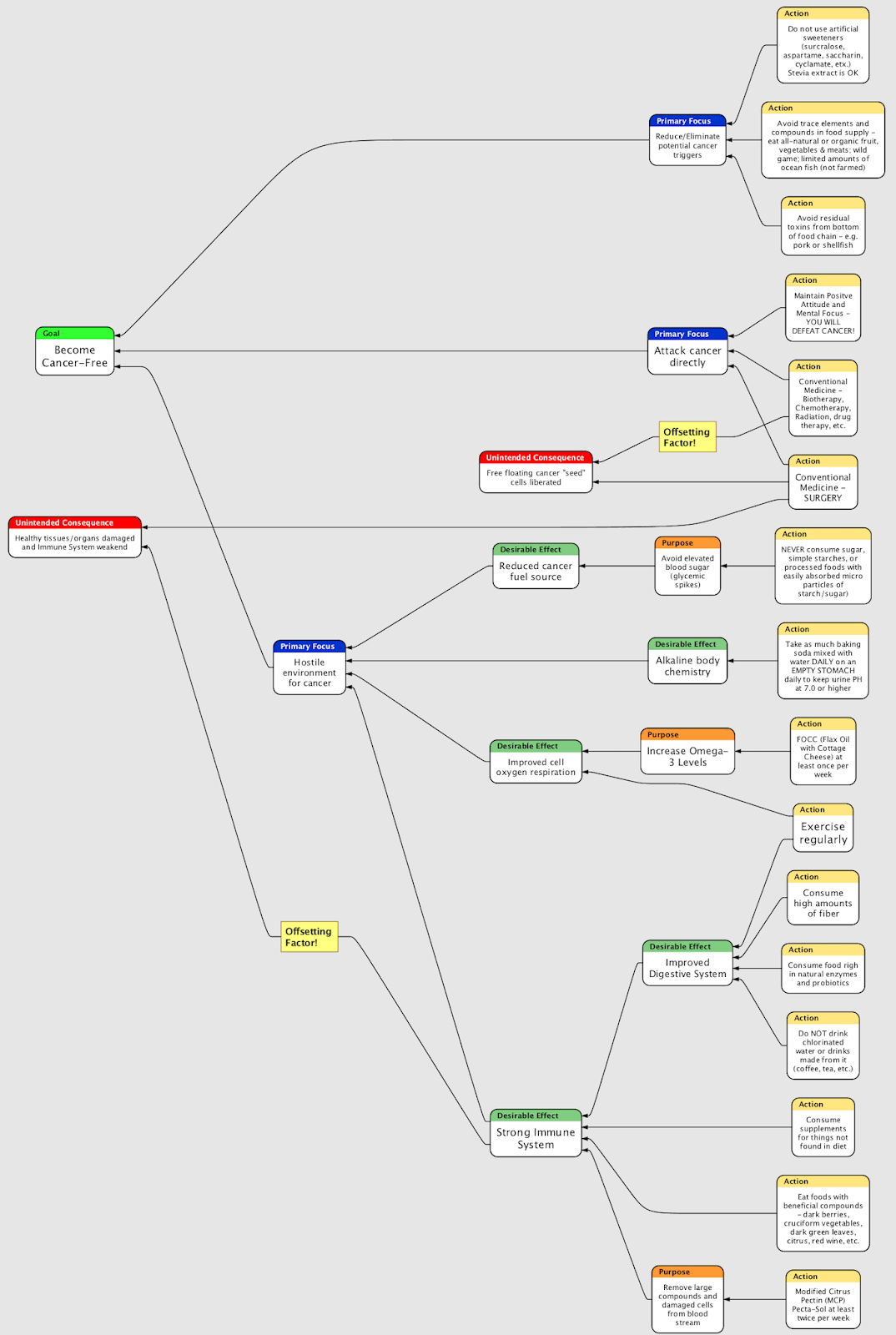
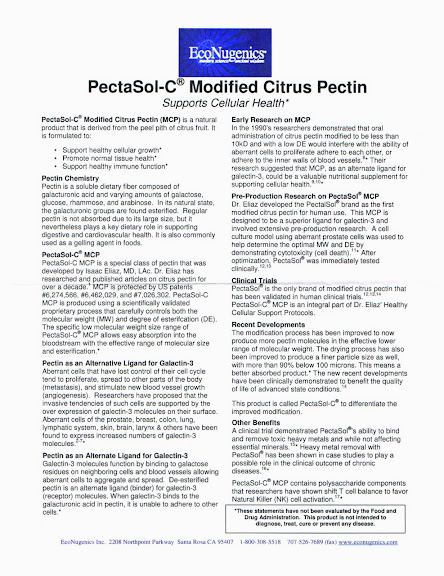
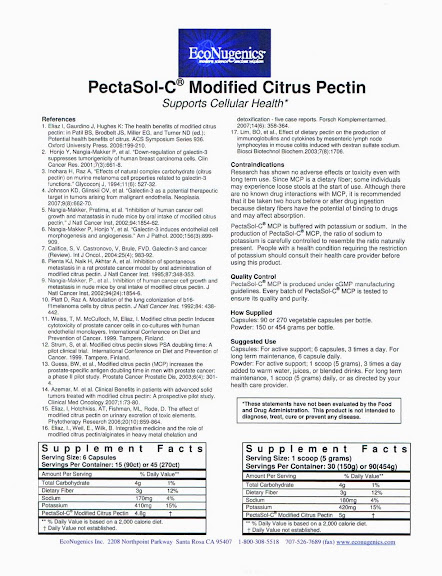
The data on MCP are not as strong as the data for Oncovite, so again a good diet will be more beneficial. MCP should not hurt anything, but it probably won't help.
And hyperthermia?
We always use localized hyperthermia in conjunction with low dose chemotherapy. This regimen is used sometimes when BCG fails.
Hyperbaric, or others?
Look, you don't need any of that. The best hope to combat the disease is to follow my recommended courses of BCG maintenance, which I outlined on the written recommendation. These things like hyperbaric and hyperthermia are to fight cancer. You don't have any cancer right now, so the BCG is the thing that will best combat recurrence and progression. At this point those other things would be a waste of time and money.
What about specific dietary restrictions, such as avoiding sugar, or a radical change?
The diet you described on your medical history form is not too bad. I think there are a few changes that you could make to do better. I imagine you may have already implemented some changes?
Yes, I would describe it as a radical change - no pork or shellfish, no sugar, no processed food, no processed flour, no fried food, and organic or natural on everything else.
Well that's pretty close to what I'd recommend. You need to make sure that you are getting a minimum of 10 servings of fruit or vegetables daily.
We're in the early restrictive phase of the diet, but we will be up to that by next week.
Excellent. I will send along a report on foods and supplements that you might want to consider in addition. And if you keep up this type of diet, I expect your gout will clear up on its own. Limit red meat to once per week. Here's your order of focus:
1) The most important thing to do is the BCG maintenance as I've recommended in your report
2) The next single biggest contributor to keeping cancer-free is a permanent dietary change along the lines you are doing now. A vegetarian diet is optimal for reduction of carcinogens, so limit animal protein.
3) The next most critical thing is to do some form - any form - of regular exercise. Jogging, swimming, biking, whatever. It has to be more than walking around your office building.
I was afraid you'd say that last one!
{Laughs}
If no cancer is observed on October 23, do the BCG?
Yes.
Do you recommend any other diagnostics?
FISH urine test. Do it at six months. You had a positive FISH before, and a positive FISH at 3 months may be false. BCG needs six months to work, at which point you need a negative FISH result.
If cancer is observed on the October 23 cystoscope, is radical cystectomy is indicated?
If it's something less than high grade T1, you cannot conclude that BCG has failed. It takes six full months to do its work.
Can that grading and staging be determined via cystoscope?
No. You always have to resect to see what it is.
(This appears to be a significant difference of opinion from Dr. Hopkins and Dr. X)
For high grade or progression, radical surgery is indicated?
Yes, remove the bladder and 10-15% of the lymph nodes. For urinary diversion I recommend the orthotopic neobladder. I think you'll be happier with that.
(Dr. Lamm did not mention prostate, but I infer that it is also removed)
How long would I have to arrange for it and get it done?
Three months maximum.
I understand there are significant risks for loss of sexual function, incontinence, or no-continence associated with radical surgery.
Not significant if it's done properly.
Any pouch or neobladder techniques better than others?
I recommend an orthotopic ileal neobladder. It will preserve a normal lifestyle for you.
Any surgeons you would recommend for the radical cystectomy?
Well, there's a fellow in Phoenix, Arizona that I like a lot. His name is Lamm. {Laughs}
I thought you had retired from the surgery business?
Not at all. I did one last week. I do two to three every month.
If BCG maintenance continues, how long before we go back to TURBT and restart everything?
It depends on the grade. I might advise chemo plus hyperthermia. And I would never want you to reinduct with six BCG treatments. We would likely go on extended maintenance BCG, reducing dosages based on your reaction symptoms.

We thanked Dr. Lamm and concluded the call. In short order I received his written second opinion, which was a full page summarizing my history and a half page of specific recommendations. I also received his dietary advice in a separate file. The recommendation portion of his report appears below:

Impression and recommendations:
1. High grade, T1 bladder cancer with high grade Ta recurrent TCC on repeat resection. He is now post 6 week induction BCG, which was tolerated with moderate symptoms. He had Mitomycin C after the repeat resection, and not after the first due to bladder perforation. He has been offered cystectomy with ileal loop diversion and has elected (appropriately in my opinion) a trial of BCG immunotherapy. At his young age he would appear to be a candidate for an orthotopic ileal neobladder should radical cystectomy be required. I believe he would be happier with that diversion. Extended lymphadenectomy should, in my opinion, also be done if cystectomy is required. I would strongly recommend that he receive 3 week maintenance BCG. With his symptoms during the first course I would
recommend reducing the dose to 1/3 and giving up to 3 instillations at 3, 6, 12, 18 and 24 months, then yearly to 6 years, then at 8, 10 and 12 years to reduce the increased risk of disease progression after 10 years as reported in the Memorial Sloan-Kettering series. He now has an exceptionally good diet. Neither Oncovite nor Intron A significantly improves disease free status when the above maintenance schedule is used, but should be considered if he fails or does not receive the optimal schedule as described above. While CIS has not been seen, with high grade/recurrent disease it may be present, and he is certainly at long term risk for recurrence, progression and extravesical disease in the prostate and upper tracks. Periodic CT urogram and biopsy of the prostatic urethra and upper tract cytology may reduce that risk. I would recommend repeating his FISH at 6 months, and would follow him with cystoscopy/cytology every 3 months for 2 years, every 6 months for 2 years and then yearly. At his request I will send him a list of dietary and nutritional supplements that some evidence suggests is beneficial in bladder cancer. I also recommend regular physical exercise.

Don Lamm, MD
Certainly a better outlook than what I got from Dr. X, and much more helpful on a practical level. It's a bargain at $300. As I had agreed, I forwarded the BCG regimen and a copy of the full Lamm report to Dr. X via email. He replied quickly with a brief "Thanks for the update. Sounds like a reasonable plan." I need to get this Q&A summary, the Q&A summary from Dr. X, Lamm's full report and dietary recommendations, and Dr. X's reply to Dr. Hopkins for his review and consideration. Dr. X had felt that Dr. Hopkins would be willing to adopt Lamm's approach without question. My preference would be that Hopkins and Lamm would collaborate on my case. I'd certainly be willing to pay for it. Stay tuned...

Second Opinion #1 from Dr. X in Indiana - September 1, 2008

I traveled from Utah to Indianapolis last Thursday-Sunday, and I stayed with Lee, a good friend from college (like Dr. Chuck). We saw the original cast of Beatlemania in their Magical Mystery Tour concert, we did some hiking in the woods, and we managed to take in a AAA ball game where the Indianapolis Indians spanked the Louisville Bats handily. I also had an appointment with a urological oncologist who had been described by my doctor as "brilliant" and whose credentials had been approved by Dr. Chuck. Naturally my expectations were high, and probably unrealistic. I had hope that he would confirm that the diagnosis was either correct or perhaps even less severe. I expected he would be familiar with cutting edge treatments in the field - perhaps some that Dr. Hopkins was unaware of. I wanted him to tell me if additional risk was created from the bladder puncture in the first surgery, and what could/should be done about that. I wanted to quiz him about best-case and worst-case scenarios, and I thought he might have information on more than the two options I had heard to date (BCG best case, radical cystectomy worst case).

The problem with high expectations is that your probability of being disappointed is also high. And so it was with my second opinion. While the doctor was as helpful as he could be, and he took longer than he planned to answer all my questions thoroughly, most of my hopes and expectations were not realized. He had not reviewed my records in detail. He did not personally verify the diagnosis. And most of all, he made it clear that he only supported courses of actions that had been thoroughly tested in controlled environments with sufficient test subjects that were published in peer-reviewed journals. While this is both safe and prudent for him, it limited the information he provided to things that would have been easy for me to research on my own. While I did learn some new and valuable information, it was not worthy of my time investment. So I do not recommend him specifically, and I will refer to him as Dr. X. There's no issue with Dr. X - he is certainly representative of mainstream medical opinion. And therefore
there is no reason for you to seek him out rather than a competent physician in your local area. The following is a summary of my consultation with Dr. X on Friday, August 29, which lasted for more than an hour.

Dr. X made a great effort to distinguish between cancer RECURRENCE and cancer PROGRESSION. The most important factor in determining whether to continue with BCG treatments and simple TUR surgeries is whether or not the cancer PROGRESSES. If you have read any of my other posts, you know that my cancer has been classified as T1 and Grade 3 (T1-G3). The T score is known as "staging" and it measures PROGRESSION. Grade is the strength/differentiation score. A great summary of bladder cancer basics may be found HERE. Like in golf, low numbers are better than high numbers. So if you have bladder cancer, T1-G1 is a nuisance to deal with for lifetime, but it is very unlikely to progress. If you have anything more, progression (e.g. going from T1 to T2, T3, etc.) is a guessing game. Grade and recurrence are the only tools widely used to judge probability of progression. My G3 is the max bad score you can have, and my chance of PROGRESSION is already high. If RECURRENCE happens quickly, the indicators that the cancer will PROGRESS are maxed out, and the standard treatment is radical cystectomy. Dr. X. flatly stated that
radical cystectomy has the single, highest survivability statistics over any other standard treatment. It also has a lot of risk and lifestyle impacts, so most patients (myself included) want very much to avoid it. Next we went into my list of questions.

Do you concur with the grading and staging of my cancer?
Yes.
Did you look at the reports, slide images, or both?
My staff usually looks at the most detailed data they can get. I'm not sure if they were able to get the slide images for you or not.
Do you concur with the diagnosis and recommended course of treatment?
Yes.
Were any additional risks added from the bladder perforation during my first TURBT?
Theoretically there is a small risk, but nothing has ever been proved to propagate from a perforation. So I don't believe there is any real additional risk.
Would any additional diagnostics be useful?
The only thing you can do is another CT scan.
That would only work after something got big enough to be a problem, correct?
Correct.
What about an exploratory surgery?
You could not see anything that way until it got big enough to see visually, so it's no better than the CT scan. And nobody would do it.
The radiology report from my CT scan indicated inflammation possible outside the bladder and/or in the transverse colon. Is there a probability or risk of abdominal or lymphatic cancer already in progress?
You would have to ask a gastrointestinal doctor for specifics, but I find it doubtful.
How would it be diagnosed?
Via colonoscopy.
I'm scheduled to get my first one of those next summer after I turn 50. Do you believe the report suggests I should get one sooner?
No, that should not be necessary. Again, you could ask a GI doctor. (Looks like a question for
Dr. Chuck)
I have heard that cancer does not like oxygen. My house is at about a mile elevation. Is that a concern? Should I consider supplemental oxygen?
No. Not at all.
Do you have an opinion on complementary therapies in addition to the BCG, such as vitamins, MCP, hyperthermia, hyperbaric, or others?
Nothing has been proven to my satisfaction to be helpful. Of course, any of these things COULD help, along with Taxol or other stuff from the Amazon rain forest. There would be an underlying chemical basis, and that would need to be studied and tested under controlled conditions. Just make sure that anything you try won't hurt you, and it's possible that some of it might help.
What about specific dietary restrictions, such as avoiding sugar, or a radical change?
Won't matter. You already have cancer and nothing in diet can change that. Diet MIGHT help someone avoid getting cancer, but once you've got it, you've got it. (NOTE: I do not agree with Dr. X on this subject)
So there's really NOTHING I can do in addition to the BCG to improve my odds?
I doubt it. I think you're doing everything you can. Just make sure you don't try anything that might hurt.
Did you read the information about Oncovite or MCP in my materials?
No.
What are my odds at this point?
We have to segregate your RECURRENCE odds from your PROGRESSION odds. Your odds of PROGRESSION are 50%. Your odds of recurrence are significantly higher than that. Early recurrence for your grade (G3) is a strong indicator for progression.
How long before the recurrence is not considered "early" and we can go back to TURBT to remove it?
I'd say a year to two years. I really like that one-year threshold, myself. I'd go back to TUR for a patient who had no recurrence for a year, unless there's evidence of progression.
Can't progression only be evaluated through resection and lab work?
Often you can tell with the cystoscope.
Do you recommend any other diagnostics?
Urine cytology also.
I'm also doing a consultation with Dr. Lamm. Are you familiar with him and his work?
Yes, very much so. He and Dr.(I missed the name) pioneered BCG treatments, and his paper in the late 90s documented the effectiveness of maintenance therapy.
Do you have a recommended BCG regimen?
I generally do six doses, and occasionally do maintenance.
Why don't you always do maintenance, if the paper documented the effectiveness?
Because only six patients were able to tolerate the maintenance treatments to their conclusion, I think two or three years. So while the initial sample was big, the end sample was small.
Dr. Lamm has done some recent work with reduced dosages and increased frequency to improve tolerance by patients. Do you have any opinions about that?
If you are doing a consult with Dr. Lamm, you should follow his recommendations for your specific case to the letter. He knows more about it than either Dr. Hopkins or myself. I'd like to know what he recommends for my own education.
(I agreed to email him the summary.)
If radical cystectomy is indicated after my October 23 cystoscope, how long do I have to arrange for it and get it done?
If progression is observed, I'd do it immediately. I'd like you on the operating table within six weeks. If not, maybe two to three months. Say 90 days maximum.
If radical cystectomy is indicated, does that always mean taking multiple organs out like prostate, lymph nodes, etc.?
Yes. The cystectomy is really a misnomer. We will take out your bladder, your prostate, and several lymph nodes.
What about not taking the "yard sale" approach?
It's not safe. Nobody in the US would perform such a surgery. You should really not focus on this outcome. A positive attitude is going to be very helpful for your upcoming treatments.
I agree. But with potentially only six weeks to get it done in the worst case, that would not leave much time to get educated, choose a physician, get the workups, etc.
That's a good point.
I read that there's a 2% chance of dying on the table.
It used to be 3% but it's down to 1% now that you won't leave the hospital.
I have read that 30% of prostatectomy patients die within 5 years.
That's not accurate at all. I don't know the number, but it's small, like 2-3%.
I have also read that 90% of prostatectomy patients lose their "recreational facilities" forever.
Count on it. And count on a 5-10% chance of daytime incontinence and a 15-20% chance of nighttime incontinence. On the other end of the scale there's a 20% chance of needing to do self-catheterizations.
What about "nerve sparing" techniques?
Maybe there are some small improvements in this field. I'm not familiar.
Any pouch or neobladder techniques better than others?
Most common is the Studer. USC uses T-pouches. I'm not aware of any significant advantages or drawbacks to any one procedure.
Any surgeons you would recommend for the radical cycstectomy?
Bernie Bochner at Memorial Sloan-Kettering in Manhattan, Don Skinner at USC in Los Angeles (retired in 2017), or Seth Lerner at Baylor in Houston. I can get you a referral for Bochner if you need it.
What's your final summary of my prognosis?
We know certain things that work. BCG works sometimes, but we don't know the exact mechanism. Maintenance therapy works. Removing the prostate and lymph nodes in addition to the bladder works. Radical cystectomy provides the absolute highest chances of survival. Do whatever Lamm recommends for BCG for your specific case. You are doing everything you can (and more) to improve your chances. Keep a positive attitude.
Thank you for your time.

Obviously this is a lot to process. My original plan was to stay positive and focus on a positive outcome for October. I had assumed there would be ample time to research the flip side and/or try other therapies if the news is bad. Now I will have to learn more about the bad outcome while staying focused on the positive one. I hope that my session (via phone) with Dr. Lamm is more encouraging.

Second Opinion Mini-Update - August 30, 2008

Hi folks, I'm having a great time in Indianapolis visiting some friends from college. Lots of fun activities with pictures to upload. My second opinion appointment went as well as could be expected. Not much new news, not much good news, not much bad news. He confirmed many things I suspected. He does have a very different viewpoint and approach from Dr. Hopkins. So I have a lot of information solidified. Emotionally I have very mixed feelings right now, so I will wait a couple of days for all that to sort out before I give you all a final report of the findings in a posting here.

Thanks to Sandy V. for the very encouraging email she sent today!!!

Stay tuned!

Medical Second Opinions - August 15, 2008


Hello all. It's really good to be back in the swing of things. Mentally I feel absolutely great. Workwise it's been a pretty busy week. Physically I'm up to nearly "normal" feeling. One problem is that I have been pretty much a part time employee of late, with all the medical stuff and recovery. Did a lot of working from home, too. You can see from my keyboard at right that the office needed some attention (just kidding). I worked a very busy and full week, ending with teaching a class all morning on Friday. Working does require some mental "heavy lifting," and teaching a class of precocious engineers and support personnel is physically exhausting. The class seemed to go well, and that's a good thing indeed! I was pretty aggressive getting back in the saddle this week, but pushing myself a bit is probably not a bad thing at all. A bit tired after it all. And there is lots more stuff to do in my backlog. There is no question that the person with the biggest load is my boss, and I am eager to do more to take a piece of that off her plate. I should probably get one of the signs at left for her office, though!

Today's topic is Medical Second Opinions. Everybody told me that you have to get one, and I am now getting around to it - in fact, I'm getting two! So why should everyone get a second opinion? It's not so much that you expect the other doctor to say, "Cancer? You don't have anything like that. It was all a big mistake. Never mind!" While that would be welcome news, it's not realistic. What you want the second opinion to do is validate the diagnostic procedures used, the conclusions reached, and the treatment recommended. The best outcome is that the second opinion is exactly like the first one. Grading and staging cancers is a bit of an art, though, so you might find out that another doctor thinks your case may be better or worse than the first doctor. No issue if the treatment plan would be the same, but a big issue if deciding whether to do radical surgery or not! Also the doctors have different experiences and may recommend additional tests and/or treatments for you to consider. Independence is desirable, but not mandatory. In my case one of the second opinion doctors knows Dr. Hopkins very well, so perhaps they might even collaborate some on my case. Then you have the leverage of two experts working on your behalf. And if they have different recommendations for the path ahead, you have a decision to make. So it pays to use the resources at hand. Most insurances pay for it, so why not get it done?

How to proceed? This is not so obvious. Your current doctor can recommend someone, or for more independence you can get a list of the board-certified urologists in your area pretty easily from the American Medical Association at THIS LINK. It's a difficult process to become board certified, so this means the doctors are both qualified and motivated to undergo the process. Other docs not board-certified are usually OK, too. I checked out several in Salt Lake City that might have been fine, but I chose to look for more of a "superstar" doc for second opinion. Dr. Chuck helped me find one, and we hope the effort proves fruitful. I will have to incur some travel expenses to go out of state, but it's a small price to pay. If you are wondering why I have not disclosed the name of the new doctor, it's because I want to make sure the experience is generally positive first. Then I will name him, recommend him, and publish his contact info. If you want to stay near home, going to a separate medical center in your area might be good. I looked into the Hunstman Center in Salt Lake City, and they were very prompt and helpful in responding to my email, as you can see below...
Thank you for contacting the Huntsman Cancer Institute. I am sorry to hear about your bladder cancer and I hope this information will be helpful to you. Please share this information with your physician as I am not a doctor and cannot recommend any medical advice. Obtaining a second opinion is a wise course of action with any cancer diagnosis. It provides you with a different perspective of your disease and will provide you with an additional option for treatment or confirm the opinion of the first physician. Although I cannot recommend one specific urologist, I can give you contact information for our urologic oncology department that specializes in your type of cancer. Their website is http://www.hci.utah.edu/group/urologic/program.jsp and you can contact their patient coordinator, Dustin Banks at 801-587-4381. You may also want to search for local board certified urologists at https://doctorfinder.ama-assn.org/doctorfinder/home.jsp?

Finally, I have attached a brochure that can be helpful in communicating with your doctor to make sure you have covered all of your bases. "What Questions Should I Ask My Doctor Now That I Have Been Diagnosed with Cancer?" (Huntsman Cancer Institute) http://www.hopeguide.org/hope/ResourceDetailCMD.jac?searchString=&score=0&resourceID=3429&referer=/faq.jsp I hope that this information is helpful. Please visit our Cancer Learning Center website (www.huntsmancancer.org/clc) where you can search for books, videos, DVDs, CDs, and CD-ROMs available for check out. For more cancer resources and information online, visit the HOPE Guide (Huntsman Online Patient Education) website at www.hopeguide.org. If you need more information, or if you can’t link to any of these websites, please let us know. We are happy to answer any further questions and to send you these documents in the mail. I wish you all the best.
I am preparing a list of questions for the new docs to answer during our consultations. Here's what I have so far. Your inputs and suggestions are also welcome.

Questions for Second Opinions
1) Validate bladder cancer grading (G3) and staging (T1)
2) Validate diagnosis and treatment recommendations
3) What particular risks were added due to bladder perforation during TURBT #1?
Any additional diagnostics or treatments indicated?
4) Opinion on adjunct therapies (complementary not substitutes)
Vitamins – Oncovite, fish oils,etc. (currently taking)
Modified Citrus Pectin – chelating agent (currently taking)
Hyperthermia
Hyperbaric
Others recommended or to avoid?
5) Specific Dietary recommendations?
6) If no cancer observed October 23, 2008 cytoscopy, recommended treatment
Additional diagnostics to cystoscopy recommended and when?
Additional treatments to BCG therapy recommended and when?
7) If cancer observed October 23, 2008 cytoscopy, recommended treatment
If radical cystectomy indicated, include prostate or other tissues/glands/organs?
Associated risks of not doing prostate, etc.?
If radical surgery indicated, how long can it be postponed & what are associated risks?
8) If BCG therapies continue, how long before TURBT could be indicated vice radical surgery?
It's great to live in a country where there are so many resources eager to provide help and information. I encourage you to take advantage of them and get a second opinion - or two!

BCG #6 Full Report - August 8, 2008

Happy Crazy 8's Day! (8/8/08) I feel much better than yesterday by contrast, though pretty tired and sore in the bladder region. Side effects have cleared up, so once the soreness improves I should be on track to "normal" again. Instillation was a piece of (sugar-free) cake. Dr. Hopkins looked at the log of the first five treatments and said it was consistent with his expectations - increasing symptoms week by week. He said to expect a bit worse for this round, and he was right about that! I also told him that I had chosen a doc in another state for second opinion via a roundabout way (Dr. Chuck), and that it was probably someone he knew. He was instantly curious, and it turns out the doc in question was a year behind Hopkins during urology internship and residency at Indiana University. Dr. Hopkins had high praise for his colleague, describing him as "brilliant, dedicated, and hard-working." Just the sort you would want for an opinion. Then he added, "Tell him that I taught him everything he knows!" jokingly, and gave me a note to pass on. We all hope that the BCG will do the trick, but Dr. Hopkins affirmed that there's no point in scheduling the next rounds of BCG until after the cytoscopic inspection on October 23 - Judgment Day. He asked if we had any questions and left us on our own.

I will be setting up a transmittal of records and scheduling an appointment with the brilliant doctor next week. Dr. Chuck also advised me to go ahead and do an "e-Consultation" with Dr. Lamm in Arizona - good for a potentially different point of view and a bargain at $300. I believe my insurance will cover the consult from the other doctor, but not the travel expenses or the Lamm consult. In the big picture it's a small price to pay. I will ask both of the docs to confirm the diagnosis, grading, and staging, review the treatment plan, and discuss alternatives for what should happen after the cystoscopy whether new growth cancer is observed or not. More on this topic will be discussed in a later post.

Even though the waiting room was empty, Dr. Hopkins was busy and running late. BCG was not instilled until 11:15AM (from our 10:30 appointment). Endless summer construction had shut down half of the northbound Interstate, and it took about 80 minutes to get home. Did my normal hydration routine, and side effects hit about an hour after I voided the initial BCG, earlier than ever in the past. They got worse quicker and lasted longer, too. I increased hydration to try to fully flush the system and ended up going 3-4 times per hour. This approach did the trick, but put more stress on the bladder and associated systems. By 5 PM I had a mild headache, a full blown stomach ache, abdominal cramps, bladder pain, no appetite, etc. No one of these symptoms amounted to much, but having them all for most of the day was pretty miserable. My entire day is well-summarized by the T-shirt at the left. (And no, I don't want one!) Visible side effects were mostly gone by 10 PM, and I was up every hour or so through the night draining out the remaining liquid. All the details are now updated at the bottom of the Installation Page (2/10 on the gross out scale). I was drinking a lot of iced tea (at room temperature, sweetened with stevia); water flavored with organic lemon/lime/orange juice and sweetened with stevia; and spicy lemonade* for variety. But apparently there's a soft drink made and distributed in the African country of Ghana that might have been more appropriate - see photo at right...

Friday has been much better. Got up early and started slow hydration. Been "going" a bit today (not nearly at yesterday's rate), and each time there's a tiny bit less soreness and discomfort. I'm hoping that the recovery will be as early as tonight or tomorrow, and it looks good so far. Thinking is much clearer today, though less than 100%, and so doing some light work and this blog have become possible again. Will probably start the new dietary regimen and resume the MCP this weekend or early next week. My mood and attitude are dramatically improved, for which everyone is thankful.

*To make 1 gallon of SPICY LEMONADE combine:
Juice of 5-6 large organic lemons (20-24 oz)
1.25 cups (20 oz) organic Grade B Maple Syrup (you can use Grade A, but it's expensive!)
While maple syrup is less severe than table sugar or high fructose corn syrup, it's still sugar, and it still yields blood glucose - cancer's favorite food. I suggest using only stevia (a natural leaf extract) as sweetener. Since concentrations vary, you will need to experiment to find the correct amount!
1 teaspoon of organic Cayenne Pepper
10 cups (80 oz) of purified or spring water(non-chlorinated water)
The resulting drink looks like tea, due to the Grade B syrup.
Can be served cold, cool, room temp, or hot.

If you just want to try it, one serving is:
2 tablespoons fresh organic lemon juice
2 tablespoons
organic Grade B Maple Syrup
Sweeten to taste with stevia (a natural leaf extract found in health food stores)
1/8 teaspoon (or more) organic Cayenne Pepper
8 ounces of purified or spring water(non-chlorinated water)
Can be served cold, cool, room temp, or hot.